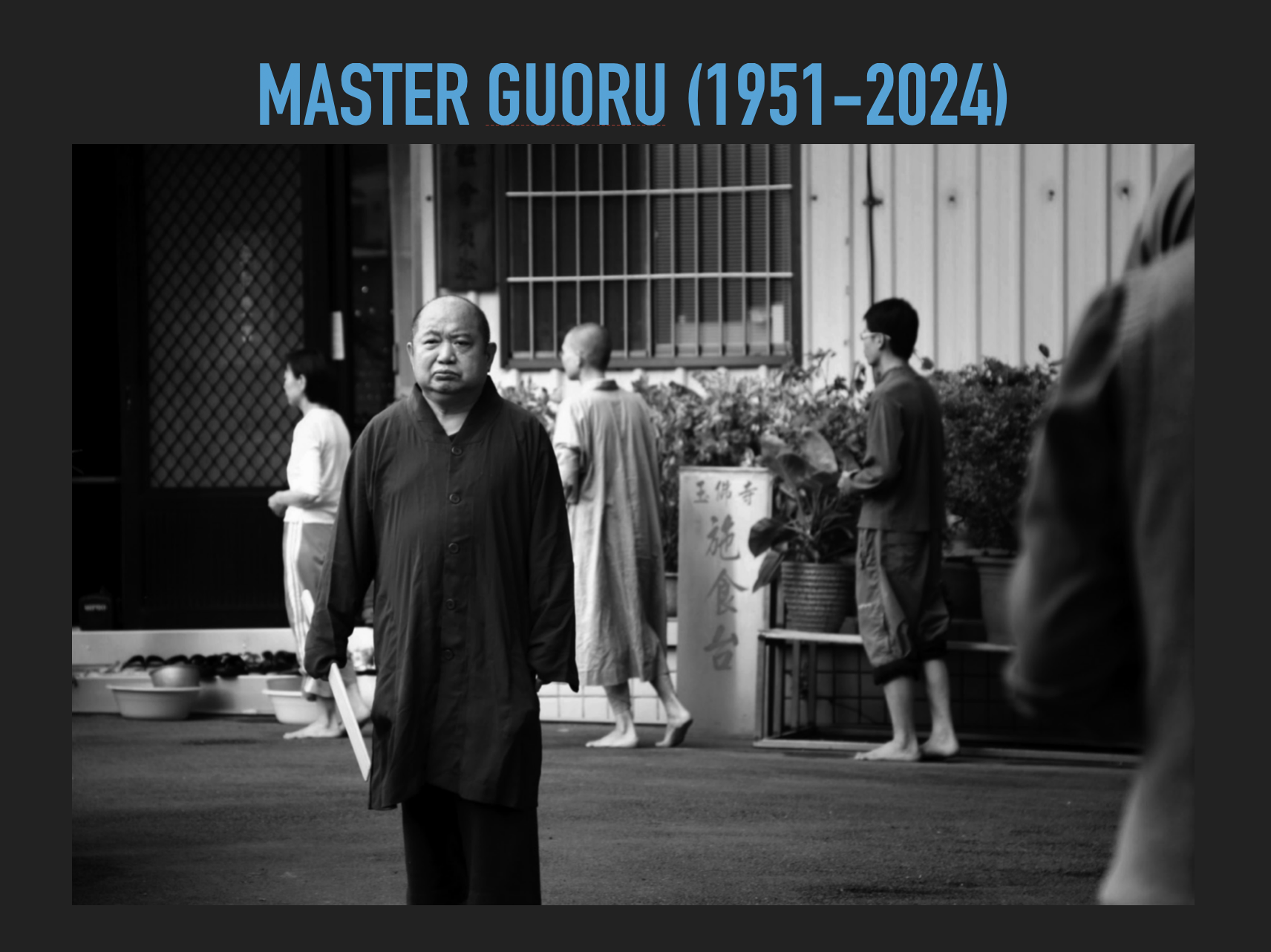
Dear Friends,
This is Jeremy Wei (Changxing Yuanding), the first Dharma heir of the late Master Guoru. I would like to share my learning experiences with Master Guoru and his core teaching: “Perpetuate the Lineage Teachings of Chinese Zen Buddhism for another five hundred years; do not allow their extinction.”
I also sincerely invite you to join me on the journey of carrying forward the lineage Zen teachings for the next 500 years. Thank you for your warm support.
Perpetuate the Lineage Teachings of Chinese Zen Buddhism for Another Five Hundred Years; Do Not Allow Their Extinction
— Respectfully written and recorded by Jeremy Wei (Changxing Yuanding), the First Dharma Heir of Master Guoru, on November 1, 2024
On the Morning of October 2, 2024, at 11:00 AM, I stood beside Shifu’s (Teacher or Master) sickbed and softly reported to him, “Shifu, Jeremy has come to see you. Please forgive Linda (Shifu’s second Dharma heir) for not being able to arrive on time; please allow her to properly complete her studies.” Shifu blinked, and loving tears welled in his eyes. Dharma brother Changpu, who hurried from Tainan and stood nearby, witnessed this scene. Dharma sister Suxiang, a disciple who has followed the master for over forty years, said that Shifu was waiting for his most beloved child to return and see him.
As I bid farewell to Shifu, what surfaced in my heart was the mission he bestowed upon me as the first Dharma heir: “Perpetuate the lineage teaching of Chinese Zen Buddhism for another five hundred years; do not allow their extinction.” Shortly thereafter, Shifu passed away at 1:00 PM on October 2, 2024.
At this moment, my fingertips pour out my feelings for Shifu, as words and tears fall onto the keyboard, solely to convey Master’s most profound teachings and share Master’s most heartfelt guidance.
Shifu has always presented a stern image, embodying a distinctive Zen style. However, the true Shifu taught according to each disciple’s aptitude, providing the most appropriate guidance based on their innate wisdom and level of diligence. Throughout his life, Shifu never scolded me or Linda, nor did he ever hit us with the Zen stick.
Recently, some people have been discussing that Shifu’s teaching methods in his later years have changed, shifting the focus from “uncovering one’s self nature through Zen practice” to “applying Buddhist teachings in daily life.” Some individuals frequently asked Shifu how to “apply” Buddhist teachings in everyday life. However, in a panel discussion in 2023 with Master Gilbert Gutierrez, one of the Dharma heirs of Master Sheng Yen, Shifu clearly stated that like his teacher, Master Sheng Yen, his teaching methods has never changed. “My Shifu’s (Master Sheng Yen) teaching methods have never changed.” “What I teach here is how to attain enlightenment.”
Enlightenment, or uncovering one’s self nature, is the core value of Chinese Zen Buddhism. Based on the premise of uncovering one’s self nature, training at the Zen meditation hall and daily life are interconnected, not disconnected; daily life serves as an extension of the hall’s training. Zen practice in daily life does not involve using Buddhist principles to alleviate everyday stress or physical and mental discomfort. If it is merely for relaxation and stress relief, getting a spa treatment or psychological counseling would be more effective. Shifu often said, “It would be a great loss to regard Buddhist teachings solely as a faith to soothe the heart,” because all religions aim to comfort the heart, and without the core value of “uncovering one’s self nature,” Chinese Zen Buddhism would have no reason to exist.”
However, how can we, living in this era, embody the values of Chinese Zen Buddhism? The modernity of Zen has always been a topic of discussion between Shifu, Linda, and me. We frequently engage in enthusiastic debates on how to use the internet, video conferencing, and AI to promote Zen teachings. For us, these are not new concepts, as the “None” Zen Center (Chinese name: 無有禪社), personally named by Shifu, has been utilizing these modern media for years without ever compromising the purpose of Zen practice—uncovering one’s self nature. It is highly likely that AI will eventually become the world’s most eloquent “Dharma Teacher,” adept at reciting scriptures and explaining teachings. In such a scenario, in what form will a “Zen master” appear? What, then, is the value of a person? These are the issues that Shifu and we are concerned about, as well as the directions for promoting Zen teachings.
Can we, living in this era, truly uncover our self nature? Our Zen practice serves as a reference example.
At the end of March 2010, Linda and I participated in a three-day Zen retreat at Tianan Temple of the Dharma Drum Mountain, which was our first encounter with Shifu. Coincidentally, during the retreat, I had Dharma Brother, Qing Shui, a senior practitioner who had long followed Master’s teachings, as my roommate. He enthusiastically introduced us to Yufo Temple in Zhonghe, Taiwan.
Yufo Temple is an inconspicuous tin house located amidst rugged terrain. Shifu was surprised by our arrival and asked us, “Did you come because of your admiration for me?” We replied, “No, we don’t even know who you are.” Linda added, “We don’t even know how to write your name.” We felt that Shifu’s teachings were very different from others—very intriguing—but we couldn’t understand them at all. Shifu laughed heartily and said, “That’s very good.” Later, we came to understand that the first step in Zen practice is to admit one’s ignorance and maintain curiosity and doubt, not attempting to rationalize, nor blindly following in complete ignorance.”
Shifu then asked us how we were practicing meditation. I replied that I didn’t know how to engage with the method of huatou (or doubting meditation), but I could practice sitting meditate for at least two hours each time. I often found myself able to concentrate on my breath, experiencing the environment extending infinitely during sitting, unable to distinguish between subject and object, with time seeming nearly eternal. However, it seemed that something in my heart remained unclear. Shifu then told me that I didn’t need to practice sitting meditation anymore and encouraged me to focus on “contemplating freedom and ease.”
At that time, I didn’t understand the meaning of this phrase, so I practiced blindly. On the next two occasions when I sought instruction from Shifu, he said, “It’s okay, continue practicing, continue contemplating freedom and ease.”
One day, while driving on a highway in California, I felt my mind and the mountains, rivers, and earth merge into one. However, as daylight gave way to darkness, my mood also shifted from light to dark. I was shocked: How can my mind at this moment be “free and at ease”?
A few weeks later, I returned to Yufo Temple to honestly report to Shifu. Shifu said, “I used to think the stories in the Platform Sutra of the Sixth Patriarch were fake, but seeing you, I realized that these stories are real.” This was because Shifu, well-versed in classical doctrines, had always believed that without a doctrinal foundation, it is difficult to have an in-depth Zen practice experience. But I was like a blank sheet, almost without a background in doctrinal study. All I knew was the Heart Sutra, much like Master Huineng was when he worked as a firewood seller—I didn’t understand what others were saying about the classics. Then Shifu encouraged me, “It’s okay, continue, continue.”
The next night, I woke up from a dream and saw myself in the bathroom mirror. Suddenly, I realized, “Everything I once knew was wrong; everything I once believed was false.” Overcome with emotion, I burst into tears, and in an instant, it felt as though my world had collapsed. Upon hearing this, Shifu said, “This is just the beginning of your Zen practice.” Consequently, I became even more diligent in my practice, maintaining in a state of deep stillness for several weeks. Although my heart was filled with compassion and joy, there remained areas that were unclear. When Shifu learned of this, he replied, “Let me think.” In the afternoon, Shifu asked me, “What are the last few lines of the Heart Sutra?” As I recited, “Gate Gate Paragate,” Shifu told me to stop.
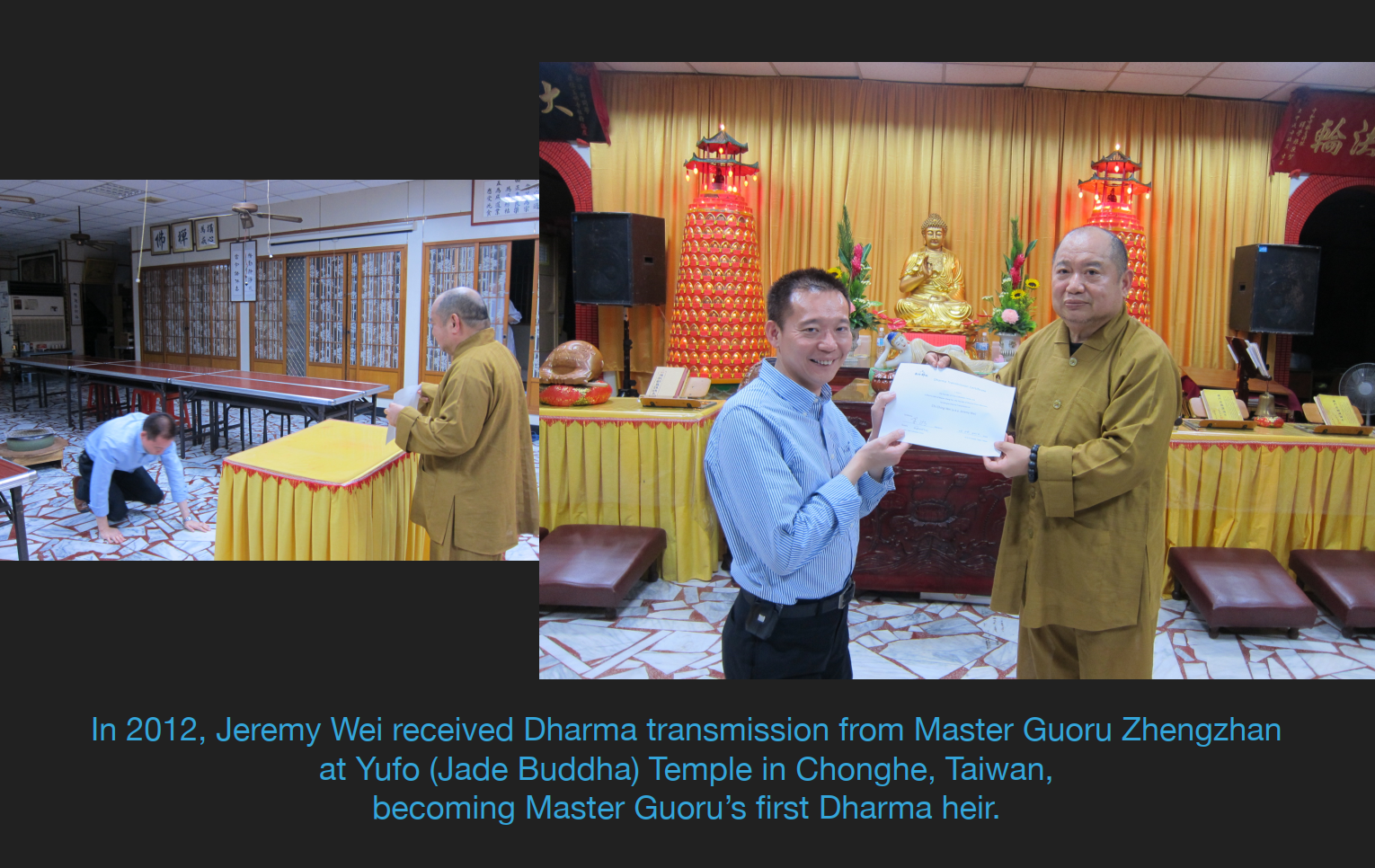
A few days later, early one morning, I went to visit Shifu. Without waiting for me to speak, Shifu happily said, “I knew it as soon as you walked in. That’s it. It is as it is. What you see is what you see.” Then Shifu closed the door of his quarters and said, “Come again the night after tomorrow with Linda, and I will confer the Dharma transmission upon you. You can transmit my teachings and accept disciples.”
I asked Shifu, “Which lineage will you transmit?”
Shifu replied, “Linji, Caodong, and, in the future, it will be the Dharma Drum lineage.”
I asked Shifu again, “What teachings will you transmit?”
He answered, “The teachings of lineage Masters of Chinese Zen Buddhism.”
I asked once more, “Who else will be able to transmit the teachings in the future?”
Shifu replied, ‘Currently, only you and I. In these two or three years, we’ll see who can truly make breakthroughs. Otherwise, in three to five years, I will also pass on the Dharma scrolls to them, hoping they can shoulder the great responsibility. Some people will be responsible for inheriting the Zen teachings, while others will be tasked with the temple’s succession. Your responsibility is: to perpetuate the teachings of lineage Masters of Chinese Zen Buddhism for another five hundred years; do not allow them to become extinct.” “True Zen teachings are always solitary. Even if only one person is willing to listen, we must speak to them. As long as there is one person who can carry on the Dharma, that is enough.'”
Two days later, on the evening of June 4, 2012, at Yufo Temple, Shifu instructed everyone to return to their rooms. After leading me in paying homage to the ancestor Chinese Zen masters, I performed three prostrations to Shifu, and Shifu formally conferred upon me the title of Dharma Heir.
The following year (2013), Linda had a great breakthrough from a very deep stillness state, and Shifu was very pleased, recognizing Linda as his second Dharma heir. Shifu tasked Linda and me with the significant responsibility of transmitting the Dharma together. The major responsibility Shifu entrusted to Linda was: “Bring the vibrant lineage teachings of Chinese Zen Buddhism to every corner of the world.”
For many years, Linda has carried this significant responsibility on my behalf. Although both Linda and I hope and welcome more people to learn Zen meditation, we avoid superficial and flashy endeavors that merely cater to the public’s preferences. Instead, we adhere to the mission entrusted to us by Shifu, steadfastly upholding the core values of Zen Buddhism with very limited resources.
The primary mission of the five-hundred-year great endeavor is to elucidate the value of “uncovering one’s self nature” and to demonstrate that “uncovering one’s self nature” is feasible, replicable, and verifiable. Only in this way can we persuade the public to restore their confidence in Zen practice. Once confidence in “uncovering one’s self nature” is lost, Chinese Zen Buddhism will cease to exist.
The value of “uncovering one’s self nature” lies in its ability to bring about a fundamental transformation in life. It grants us unparalleled confidence and strength, compassion and wisdom, enabling us to undertake tasks that no one else is willing to do, to mourn the deepest sorrows in life, to rejoice in the greatest joys of life, and to continue moving forward.
The fundamental transformation brought about by “uncovering one’s self nature” does not involve reflecting on our experiences or changing our behaviors, but rather deeply challenges our original, deeply ingrained perspectives. Humans interpret themselves and the world around them through an organized, systematic system of language and meaning. This system forms each person’s unique viewpoint and guides our daily actions. If we merely attempt to change our thoughts and behaviors through understanding, we remain operating within the original system of language and meanings. Only by going beyond or breaking through the original system of language and meaning can we create new core perspectives. This is why effective Zen practice first requires reaching the state where “the path of language is severed, and the realm where the mind can go is extinguished.”
In recent years, Linda and I have been dedicated to academic research, and through various experiential studies, we have gradually come to understand that when people encounter specific “critical incidents,” they begin to challenge their previously held beliefs, making it impossible to continue relying on their original systems of language and meaning. This leads to the development of entirely new perspectives. Such “critical incidents” can be created and simulated—in universities, they are used to enhance students’ innovation abilities; in businesses, they are used to enhance employees’ leadership skills. The traditional Chinese Zen teachings of sudden shouts and strikes can create these “critical incidents,” and we often see in Zen record sayings how the practitioners have benefited from a single shout or strike.
However, we also found that the effectiveness of critical incidents depends on factors such as an individual’s prior knowledge, the firmness of their habits, their capacity for absorption, and whether they possess the necessary skills—collectively referred to as so-called “wisdom aptitude.” Therefore, indiscriminately using shouts and strikes to create critical incidents is ineffective. For example, if practitioners lack sufficient cultural background in Zen or the so-called “wisdom aptitude,” traditional shouts and strikes may struggle to resonate. Moreover, in modern society, such actions are easily misunderstood as violence or bullying, or even deliberately misrepresented. In the future, how can we create critical incidents for Zen practice? This is an issue we are currently researching.
To extend the lineage teachings of Chinese Zen Buddhism for another five hundred years, we need to demonstrate that “uncovering one’s self nature” is feasible, replicable, and verifiable. Chinese Zen record sayings provide a wealth of examples of Zen practice, but the gap in language and era poses a significant barrier to learning—especially for someone like me, with limited literary skills, and even more so for those whose native language is not Chinese, for whom it may seem like an unfathomable text. If learning itself is “infeasible,” how can the learning experience be replicated?
Therefore, the first step is to be able to use the simplest, most straightforward language to explain or replace the traditional terms. Secondly, we must develop the capacity, based on modern empirical methods, to make the goal of “uncovering one’s self nature’ and the methods to achieve it operational, reproducible, and testable. This part of the work requires substantial effort, dedication, and resources, and Linda and I, perhaps overestimating our capabilities, are pushing forward inch by inch.
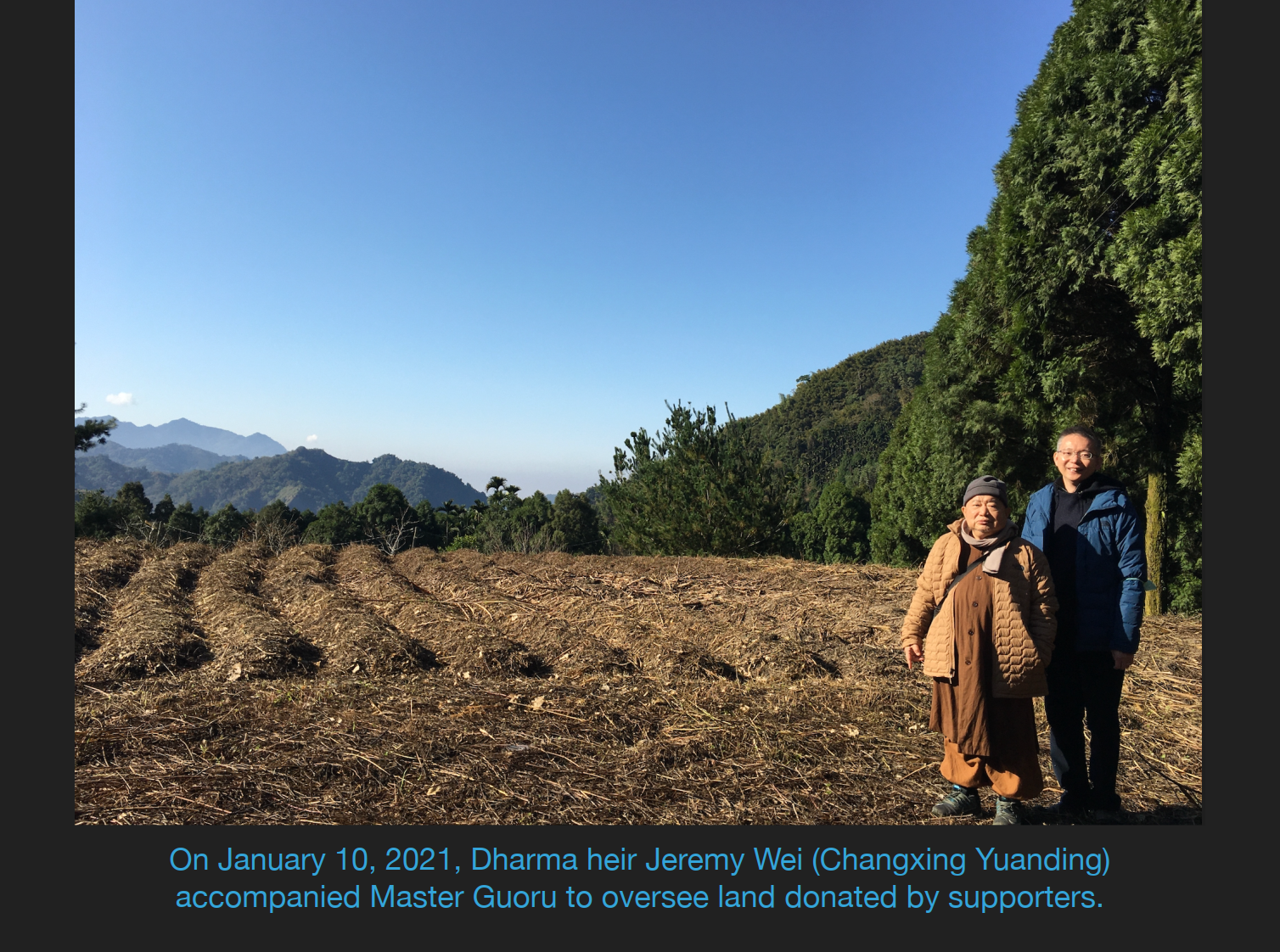
In recent years, due to various factors, I have not frequently visited Shifu’s temple. However, the bond between Shifu and I has grown even stronger than before. At the beginning of the year, Shifu gathered the monastic community and asked me to speak to everyone. My main point was: “If one falsely claims not to seek uncovering one’s self nature or not to propagate the lineage teachings of Chinese Zen Buddhism, it is simply because they have not yet gained strength from Zen practice and do not understand its fundamental principles. If one cannot convince themselves, they naturally cannot develop genuine confidence.”
Reflecting on Shifu with gratitude for his teachings, we disciples should take uncovering one’s self nature as our foundation and refugee and make it our mission to carry forward the heart flame of the lineage masters, extending the lineage teachings of Chinese Zen Buddhism for another five hundred years. #
 None Zen Center 無有禪社